_Look effortlessly handsome by pairing this Stylish T-Shirts. Look fashionable!_ Catalog Name: *
June 10 Muni Service Changes Adds Service on Connector Routes By Clive Tsuma The 38R Geary Rapid will run every 6 minutes starting June 10 Starting Saturday, June 10, the SFMTA will be adding Muni service on several lines to address crowding, wait times and to support increased summer tourism. We’re also making some stop changes to serve more customers and make the service more accessible and reliable. Increased Service To address crowding and reduce pass-ups, we’re adding service on the 1 California between Clay and Drumm streets and California Street and Presidio Avenue – where demand is highest – on weekdays from 7 a.m. to 7 p.m. We’re also going to be starting service earlier on the 1X California Express, at 7:30 a.m. instead of 8 a.m., in response to customer feedback, as well as adding stops at Cherry, Spruce and Laurel streets and Presidio Avenue. We’re also extending the evening service to the Presidio at 30 Stockton seven days a week. The l...
Director of Transportation Report: February 4, 2020
- लिंक पाएं
- X
- ईमेल
- दूसरे ऐप
Director of Transportation Report: February 4, 2020
By
Published February 08, 2020 at 03:43AM
https://ift.tt/38av5sz
By

In this week’s Director’s Report from the SFMTA Board of Directors meeting, Jeffrey Tumlin gave updates on the following topics:
Vision Zero
- Unfortunately, there has been one fatality since the last report; a collision involving a motorcycle and private vehicle on January 26th near 14th and Mission. The collision resulted in the death of the motorcyclist. The incident is under investigation.
- The Rapid Response Team has no recommendations at this time.
Culture Change
- Met with divisional leadership to reinforce awareness regarding Mayor Breed’s directive to track outcomes by race.
- Ongoing meetings with ChangeSFMTA and the Black and African American Affinity Group (BAAAG), engaging both groups and individuals within the groups in support of the larger agency context.
- Proposing a new Office of Race, Equity and Inclusion.
Bus Acceptance
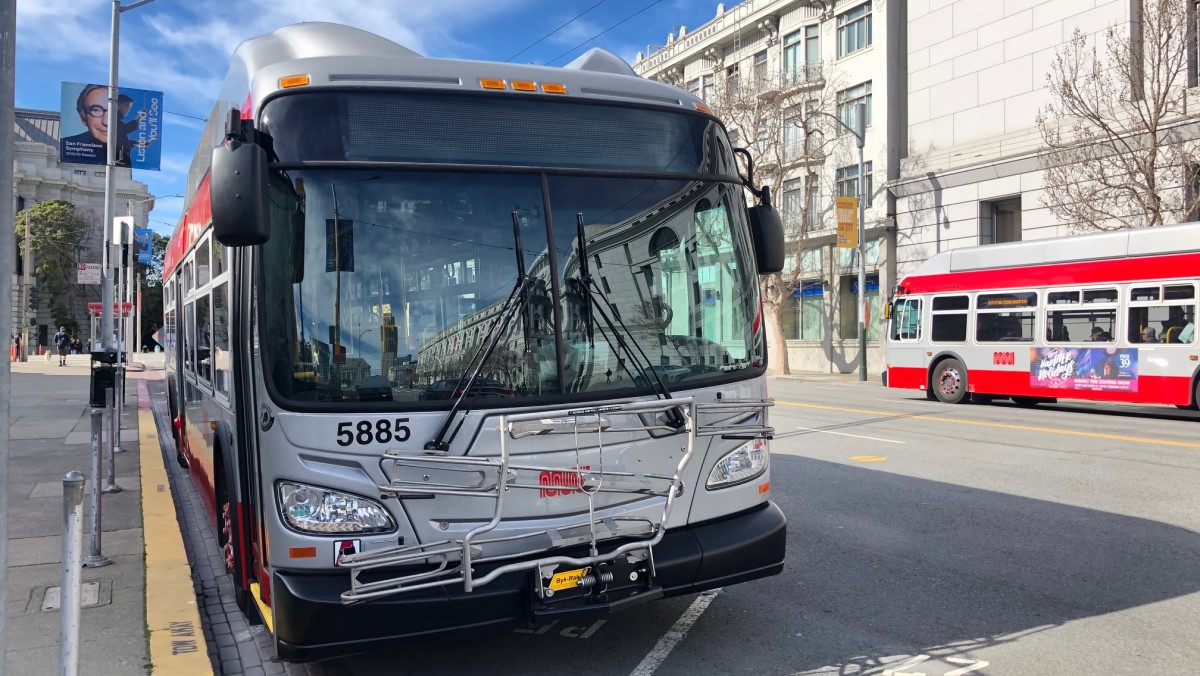
- The arrival of this trolley bus marks the conclusion of a historic rubber tire fleet replacement program, enabling us to retire our least reliable vehicles and expand the fleet; 814 new buses since 2013.
- These New Flyer vehicles have dramatically improved fleet reliability from an average of 3,000 miles between failures to 10,500 miles between failures; 71 percent further between breakdowns.
- All Trolleys are now equipped with an energy storage system (ESS) battery allowing the Trolley to drive limited distance off wire in the event of an emergency or reroute.
Market Street Update
- Thanks to our crews who were able to deliver most of the work in time for the ribbon-cutting.
- Bicycle improvements are continuing at some intersections with work on red transit lanes ongoing throughout the spring.
- Tremendous support from parking control officers with about 12 to 18 being deployed during peak hours to reinforce the new turn restrictions.
- Officers from the San Francisco Police Department have a very visible presence as well.
Our Board of Directors meeting is usually held on the first and third Tuesdays of each month. To watch the meeting in full, go to SFGovTV.
Published February 08, 2020 at 03:43AM
https://ift.tt/38av5sz
इस ब्लॉग से लोकप्रिय पोस्ट
Effective, Equitable, and Resilient Transportation for San Francisco
Effective, Equitable, and Resilient Transportation for San Francisco By Lulu Feliciano As we emerge from the current pandemic, what does an effective, equitable, and resilient transportation system for San Francisco’s future look like? Last week, just such a forward-looking vision was published by ConnectSF. ConnectSF is comprised of staff from the SFMTA, the San Francisco County Transportation Authority and the San Francisco Planning Department. With input from residents, community and business groups, youth organizations, and other stakeholders, the collaborative’s Transit Investment Strategy lays out a vision for reinvesting in the city’s transit system. The Vision ConnectSF is advancing a bold vision for the future of our transportation system. In order to realize this vision, we will need to invest in creating a system that is better than before – faster, more reliable, and more accessible. The investment strategy details the big changes we envision and where we will need f...
SFMTA Retires the Orion, First Hybrid Bus in Cleanest Transit Fleet
SFMTA Retires the Orion, First Hybrid Bus in Cleanest Transit Fleet By Clive Tsuma San Francisco’s first low-emissions electric hybrid Orion bus Muni’s Orion hybrid buses are headed for retirement as we phase in a brand-new batch of El Dorado hybrid electric buses . It’s the end of an era for San Francisco’s first low-emissions electric hybrid fleet that travels the city’s toughest routes. Orion hybrid fleet tackles Muni’s toughest routes starting in 2007 The Orion buses have been a testament to the SFMTA’s commitment to the latest green transportation technologies . Muni, which previously had relied on a diesel bus fleet in coordination with our electric trolley bus fleet, transitioned to its first 30-foot Orion diesel hybrid-electric buses in 2007. This was the start of the SFMTA’s addition of these lower emission vehicles to one of the greenest fleets in the country , ensuring better air quality city wide. The Orions brought the agency closer to achieving its goal of a...
The 115-Year History of Streetcars on Market Street
The 115-Year History of Streetcars on Market Street By Jeremy Menzies With the F Market & Wharves returning to service on May 15th, here’s a brief look back through the past 115 years of streetcar service along Market Street, our most traveled thoroughfare. May 2, 1906 was the first day that an electric streetcar ran on Market Street. After the earthquake and fires on April 18, 1906, San Francisco was eager to rebuild, and public transit played a crucial role in getting the city back on its feet. Prior to electric streetcars, transit on Market was dominated by cable cars, which ran from the Ferry Building to the Pacific Ocean, but were considered slow and inefficient compared to the newer electric streetcar technology. With the introduction of electric cars on Market Street, people had a faster way to get to downtown businesses and rebuild from the ashes of the disaster. This photo documents the first streetcar to run on Market Street, just two weeks after the devastating Apr...
टिप्पणियाँ
एक टिप्पणी भेजें
I provided by online earnings tips, offers, business and information